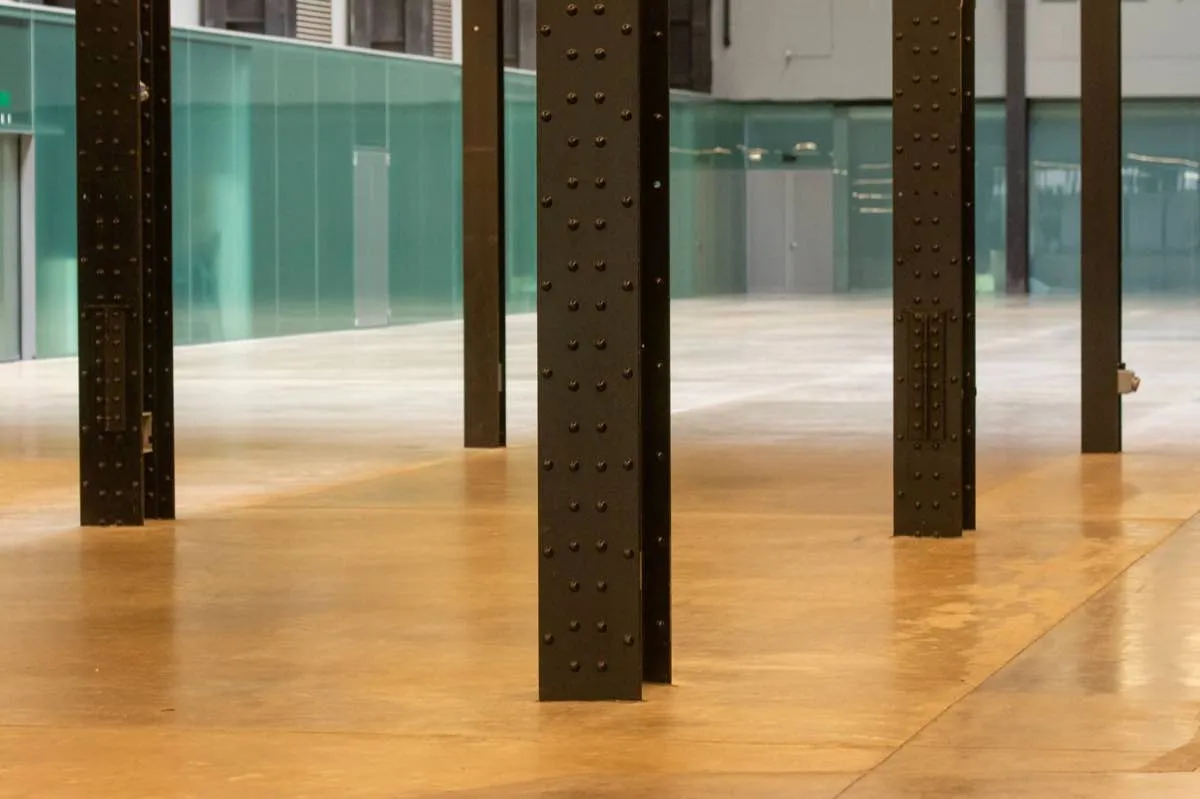
Commercial epoxy flooring runs about $2 to $5 per square foot on a straightforward warehouse job and $8 to $16 on a food-plant urethane cement system, and the number that actually decides your project is downtime, not price. Every facility manager we talk to has made peace with the cost. What keeps them up is the four days their building can't operate.
Good news: that's a solvable problem, and mostly a scheduling exercise.
Start by writing down what happens on the floor
Commercial specs go wrong when somebody picks a system from a brochure instead of from the operation. Before anyone quotes, answer these:
- What rolls on it? Pneumatic forklift tires, steel wheels, pallet jacks, and cart casters are four different loads. Steel wheels are brutal.
- What lands on it? Hydraulic fluid, cutting oils, battery acid, brake cleaner, organic acids from food, blood and fat in a processing plant, chlorides in a car wash.
- Does it get wet? If yes, you need a slip-resistance target, not a preference.
- Does it get hot or cold fast? Steam cleaning, hot water washdown, or a freezer transition means thermal shock, and thermal shock rules out most standard epoxies.
- Does anyone look at it? A showroom and a warehouse aisle have opposite priorities.
- How flat is the slab, and how old? Old slabs bring old repairs, old sealers, and old contamination.
Those six answers pick the system. Everything after is detail.
Commercial systems, and what each is for
| System | Typical build | Installed range | Where it belongs |
|---|---|---|---|
| Thin-film solid color | 10–20 mils | $2–$5 / sq ft | Warehouses, storage, light traffic |
| Flake or quartz broadcast | 20–40 mils | $4–$8 / sq ft | Shops, garages, back-of-house, restrooms |
| Self-leveling epoxy | 1/8 in | $5–$10 / sq ft | Uneven slabs, manufacturing, showrooms |
| Novolac epoxy | 20–40 mils | $6–$12 / sq ft | Chemical exposure, battery rooms, labs |
| Urethane cement / mortar | 1/4 in | $8–$16+ / sq ft | Food and beverage, thermal shock, washdown |
| Polished concrete | n/a | $3–$8 / sq ft | Big-box retail, high traffic, no coating to fail |
| ESD / static-dissipative | 20–40 mils | $6–$12 / sq ft | Electronics assembly, server rooms |
Note the last two. Polished concrete is a genuinely competitive answer for large retail and distribution floors and it can't delaminate, because there's no film. If your requirements are dust control, cleanability and light reflectance, it deserves a bid alongside the coatings.
Prep at commercial scale
Same principles as a garage, different machines.
Shot blasting replaces grinding on large open floors. It's faster per square foot, produces a consistent profile, and the steel shot gets recovered and recycled through the machine. Grinding still handles perimeters, corners, and anywhere shot can't reach.
The target profile is the ICRI CSP scale: CSP 2 to 3 for thin-film systems, CSP 4 to 5 for mortars and self-levelers. A spec that names a CSP number was written by someone who's done this.
Moisture testing is not optional on a commercial job, and at this scale the sampling plan matters as much as the method. Both methods, ASTM F1869 and F2170, want three test locations in the first 1,000 square feet and one more for every additional 1,000: a 20,000 square foot floor is 22 tests, not the two somebody ran near the door. One trap belongs to commercial work alone: suspended decks are frequently lightweight-aggregate concrete, and F1869 is expressly barred from lightweight and gypsum concrete, leaving in-situ RH probes as the only method that applies up there. Get the method, the locations and the results in writing before the first bucket opens. On 20,000 square feet, a mitigation primer at $1 to $2.50 per square foot is a $20,000 to $50,000 decision.
Joints get honored, not coated over. Moving joints get filled with a semi-rigid polyurea that supports the edges against hard wheels while still allowing movement.
Planning the shutdown
This is the part worth spending real thought on.
Option 1: full shutdown. Cheapest per square foot, fastest overall, and requires the building to stop. Standard epoxy: 24 to 48 hours to foot traffic, 5 to 7 days to forklifts. Realistically a full week.
Option 2: polyaspartic. Costs 20 to 30 percent more in material, buys you foot traffic in 4 to 8 hours and equipment in about 24. For a distribution center, a weekend instead of a week is usually worth far more than the premium.
Option 3: phasing. Isolate sections, coat, return to service, move on. Racking gets relocated in stages, its own logistics project. More mobilizations, more labor, longer calendar, but the operation never fully stops.
Option 4: nights and weekends. Premium labor rates, but the building runs normally every business day.
Ask for all four priced. The right answer depends on what an hour of downtime costs you, and only you know that number.
Specs worth putting in writing
- Surface profile: CSP number, and the method (shot blast, grind)
- Moisture test: method, number of locations, the acceptance threshold and whose data sheet it came off, results provided
- System build: total dry film thickness in mils, coat by coat
- Slip resistance: ANSI A326.3 DCOF target where the floor gets wet
- Line striping, safety markings, and cove base if applicable
- Return-to-service times for foot, cart, and forklift traffic
- Warranty term, and specifically what voids it
- Recoat plan: what the wear-layer refresh looks like at year eight
That last one is underrated. Commercial coatings are designed to be recoated. A scuff-and-recoat of the wear layer at year eight to twelve costs a fraction of a reinstall and resets the clock. Budget for it from day one and the floor becomes a 25-year asset instead of a 12-year one.
Our one strong opinion
Do not let a general contractor bundle the floor coating into a package bid without naming the system. "Epoxy floor, allowance $3 per square foot" is not a specification, it's a placeholder, and what shows up will be whatever fits inside the allowance.
The gap between a 10-mil thin film and a 40-mil broadcast system is not visible on day one. It's visible in year three, when one of them is still a floor and the other one is a maintenance line item. Name the product, name the mil build, name the CSP profile. It costs nothing to write down and it's the entire difference.
When a coating is the wrong call
Worth saying plainly, because it comes up.
If the slab is failing structurally, coat nothing. Spalling, active cracking, or a slab pumping fines through joints means concrete repair comes first. A coating over a failing slab is an expensive way to hide a problem for a year.
If the slab fails a moisture test and mitigation isn't in the budget, the honest answer is to wait rather than to install something that will fail. This is the same failure mechanism we detail in why epoxy floors peel, just at ten thousand square feet instead of five hundred.
And if all you need is a cleanable, dust-free floor in a low-chemical space, polished concrete is often the better economic answer over 20 years. We'll tell you when that's the case, even though it's a different line on our price list.
Bottom line
Spec from the operation, not the brochure. Budget $2 to $5 per square foot for warehouse thin-film, $4 to $8 for broadcast systems, and $8 to $16 for urethane cement where washdown and thermal shock are in play. Then spend your negotiating energy on the shutdown plan, because that's where the real money is.
Laredo Elite Epoxy Flooring installs commercial and warehouse epoxy, polyaspartic fast-return systems, and polished concrete across Laredo and the South Texas border region. We'll walk the floor, test the slab, and price the shutdown three ways so you can pick the one your operation can absorb. Call (855) 620-6087.
Ready for a free quote in Laredo?
Laredo Elite Epoxy Flooring — free estimate, clear scope, no pressure. Use the form on this page or jump to the homepage quote.
Related services in Laredo
Laredo Elite Epoxy Flooring money pages — go straight to the service you need.
- Commercial Epoxy Flooring →
Commercial floor work in Laredo is governed less by the material than by the lease. Tenant spaces along McPherson and Del Mar turn over between customs brokers, freight forwarders, clinics, insurance offices, gyms and churches, and the flooring contractor is almost always the last trade standing between a build-out and a final inspection.
- Urethane Cement Flooring →
Laredo Elite Epoxy Flooring installs urethane cement for wet process and wash-down floors on the border industrial corridor. Thermal shock from hot wash water on a slab that cooked all afternoon is the failure mode thin epoxy cannot handle for long.
- Chemical-Resistant Flooring →
The hardest part of specifying a chemical-resistant floor in Laredo is that the chemical list is not stable. A transload building on Mines Road handles resin pellets this quarter and drummed solvent next quarter, because the floor belongs to the building and the cargo belongs to whoever signed the last contract.
- Concrete Polishing →
Polishing is often the right answer for a slab that just failed its moisture test. A coating is a film, and a film can be pushed off by vapor moving up through concrete.
- Line Striping & Safety Marking →
Laredo Elite Epoxy Flooring lays line striping and safety marking for warehouses that move freight toward and away from the border every single day. Fork paths and staging boxes change when tenants re-slot SKUs across peak seasons and contract shifts.
Frequently asked questions
How much does commercial epoxy flooring cost per square foot?
Volume brings the price down substantially. A basic solid-color or thin-film system over 10,000 square feet commonly runs $2 to $5 per square foot. Flake or quartz broadcast systems run $4 to $8. Urethane cement and troweled mortar systems for food plants and heavy industry run $8 to $16 and up.
How long will my facility be shut down?
Standard epoxy needs roughly 24 to 48 hours before foot traffic and 5 to 7 days before forklifts. Polyaspartic compresses that to about 4 to 8 hours and 24 hours. Most commercial jobs get phased in sections or run on nights and weekends so the whole building never stops at once.
What's the difference between commercial and residential epoxy?
Film thickness, the systems available, and the level of documentation. Commercial specs usually call for a thicker build, a slip-resistance target, sometimes a chemical or thermal-shock rating, and written moisture test results. Residential work rarely needs a coefficient of friction number in the submittal.
What is the most durable commercial floor coating?
Urethane cement, sometimes called urethane mortar, is the toughest widely used option. It handles thermal shock from steam cleaning and hot water washdown, resists organic acids, and can be installed on green or damp concrete. It's also the most expensive and looks industrial, so it lives in food processing and heavy manufacturing rather than showrooms.
Do commercial epoxy floors need slip resistance?
Anywhere a floor gets wet, yes, and it's often a written spec item. ANSI A326.3 defines the dynamic coefficient of friction test used for hard surfaces, with 0.42 DCOF commonly cited as the minimum for interior wet areas. Slip resistance comes from aggregate broadcast into the topcoat, not from the resin.
Can you coat a warehouse floor without shutting down?
Usually, by phasing. Sections get isolated, coated, and returned to service while the crew moves on, with racking relocated in stages. It costs more in mobilizations and labor than a single continuous shutdown, and it takes longer overall, but it beats stopping the operation.
How long does a commercial epoxy floor last?
Ten to twenty years in light and moderate commercial traffic on a properly prepped slab. Heavy forklift traffic, steel wheels, and thermal shock shorten that. Most commercial floors get a recoat of the wear layer somewhere around year seven to twelve, which is far cheaper than a full reinstall.
Local context
How this applies in Laredo, TX
Every article here is written from epoxy flooring work done in Laredo and the South Texas border region, so the numbers reflect local labour, permit and material costs rather than a national average. Your own job can land either side of them depending on access, the condition of what is already there, and the materials you pick — 100% solids epoxy, diamond grinding and shot blasting equipment, ICRI concrete surface profile gauges.
The way to turn any of this into a real answer is to have someone look at your actual situation. The free estimate is free, itemized and written down, with no deposit and no obligation. Call (855) 620-6087 or start on the Laredo Elite Epoxy Flooring homepage.
Areas Laredo Elite Epoxy Flooring covers
Laredo first, then the surrounding communities of the South Texas border region. Each has its own page with local detail rather than a copy of this one:
- Rio Bravo, TX — Webb County, incorporated in 1989, population 4,450 at the 2020 census
- El Cenizo, TX — Webb County, incorporated in 1989, population 2,540 at the 2020 census
- Zapata, TX — Zapata County, county seat, population 5,383 at the 2020 census
- San Ygnacio, TX — Zapata County, founded in 1830, population 504 at the 2020 census
- Bruni, TX — Webb County, established in 1877, population 251 at the 2020 census
- Mirando City, TX — Webb County, established in 1921, population 222 at the 2020 census
Or jump to the full list of Laredo services.
More from the Laredo Elite Epoxy Flooring blog
- Polyaspartic vs Epoxy for Laredo Garages
Polyaspartic vs epoxy for Laredo, TX garages — cure time, UV stability, cost, and why the best systems use both instead of picking a side.
- Metallic Epoxy Floor Cost in Laredo: Worth It?
Metallic epoxy floor cost in Laredo, TX runs $7 to $12+ per square foot. Here's why it costs more than flake and when flake is the smarter buy.
- How Long Does an Epoxy Floor Last in Laredo?
A pro-installed epoxy floor lasts 10-20 years in Laredo, TX. A DIY kit lasts 1-3.
The Laredo Elite Epoxy Flooring Team
epoxy flooring specialists serving Laredo, TX
Written by the Laredo Elite Epoxy Flooring team — insured epoxy flooring pros with 15+ years serving Laredo, TX and the surrounding area.